
Key Points:
- Blossom Kidz Academy helps children build social confidence through structured, daily social skills practice.
- ABA-based strategies teach communication, friendship, and peer interaction skills.
- Early social skills support can improve long-term communication and independence.
Have you ever watched your child stand at the edge of a playground, unsure how to join in? Or noticed them struggle to find the words when they want to connect with a peer? For many parents of children with autism, these moments are painful to witness, not because their child does not want to connect, but because the tools to do so have not yet clicked into place.
Social development in autism is not simply about teaching a child to wave hello or make eye contact. It is about giving them the confidence to navigate a world built on communication, relationships, and connections. The right school environment can move that process forward in ways that are meaningful and lasting.
Why Social Skills Need to Be Taught Directly
Neurotypical children often pick up social cues naturally through observation and imitation. For many children with autism, that process does not happen automatically. Skills like reading body language, understanding tone, taking turns in conversation, or joining a group activity may need to be taught explicitly and practiced consistently.
This is where a dedicated autism social skills program makes a genuine difference. Rather than hoping social understanding will develop on its own, a structured school environment creates daily, intentional opportunities for children to learn and practice these skills.
At Blossom Kidz Academy, a special needs school in Yuma serving children with autism and developmental differences, social skill development is not a side activity. It is woven into the core of the school day.
What ABA-Based Social Skills Teaching Looks Like
ABA-based social skills instruction uses the principles of Applied Behavior Analysis to teach social behavior through structured practice, positive reinforcement, and consistent repetition. It breaks complex social interactions into smaller, manageable steps and builds on each success.
In practice at Blossom Kidz Academy, this looks like:
- Circle time discussions where students practice listening, waiting their turn, and sharing thoughts in a group
- Small group projects that build teamwork, negotiation, and communication in a low-pressure setting
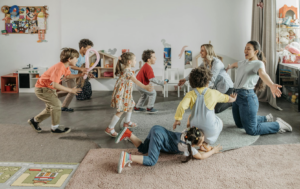
- Guided social games where children practice taking turns, managing frustration, and celebrating a peer’s success
- Peer modeling sessions where children learn from each other’s strengths in structured, supported interactions
Each activity is led by educators and therapists who provide gentle prompts and positive reinforcement throughout. Progress is not accidental. It is planned, observed, and built upon.
A Classroom Example: Learning to Join a Group
One of the most common challenges for children on the spectrum is knowing how to enter an ongoing social interaction. The steps that feel invisible to other children, pausing, observing, choosing the right moment, and finding something to say, can feel impossibly complex.
In the communication and social skills program at Blossom Kidz Academy, teachers address this directly. During structured peer play, a child who wants to join a group activity is guided through each step. The teacher models the approach, coaches the child, and then steps back as the child tries it.
When the child succeeds, even partially, that moment is reinforced and celebrated, in different settings and with different peers, the child begins to internalize the process. What started as a scripted set of steps becomes a natural part of how they engage with the world.
This is adaptive learning in autism at its most purposeful.
Building Communication Alongside Social Skills
Social skill development and communication are deeply connected. A child who struggles to express their needs or emotions will also struggle to build friendships, manage conflict, or participate in group learning.
The autism education curriculum at Blossom Kidz Academy addresses both areas together. Educators and speech therapists work side by side to support expressive and receptive language skills, body language, emotional understanding, and listening.
For children who are nonverbal or minimally verbal, alternative communication pathways are built into the program. These include picture exchange systems (PECS), sign language, and augmentative and alternative communication (AAC) devices. The goal is always the same: to give every child a way to connect and be heard.
How Early Intervention Shapes Long-Term Social Development
Research in pediatric autism education consistently shows that early intervention produces the strongest outcomes. When children begin receiving structured social support during their formative years, the skills they build carry forward into every area of their lives.
Early intervention social programs do not wait for a child to fall significantly behind before acting. They build a foundation of communication, cooperation, and self-awareness from the very beginning of a child’s educational journey.
At Blossom Kidz Academy, the early intervention approach means identifying each child’s specific needs and designing a plan that targets growth from day one. Families who seek this kind of support early give their children a meaningful head start.
Inclusive Classroom Programs That Support Every Child
A well-designed inclusive classroom program creates an environment where every child can participate meaningfully, not just academically but socially. Children with autism benefit from being around peers who model a range of communication styles, and they benefit equally from structured guidance that helps them make sense of those interactions.
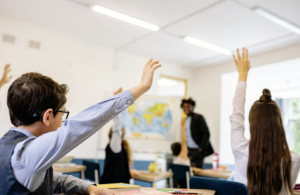
The full-day education program at Blossom Kidz Academy provides consistent exposure to these opportunities across the entire school day. Social skill-building activities happen during academic lessons, transitions, mealtimes, and play. This consistency matters enormously for child social skill development, because skills learned in isolation rarely transfer as effectively as skills practiced throughout the natural rhythms of the day.
Tracking Progress in Social and Communication Skills
Progress in this area looks different for every child, which is why the team at Blossom Kidz Academy uses individualized, ongoing assessment to track growth. This includes:
- Speech and language evaluations by licensed professionals
- Classroom observations focused on social and emotional engagement
- Regular progress reports shared with families
- Parent-teacher conferences to review goals and next steps
Families are active partners in this process. The school provides practical strategies that parents can use at home to reinforce what children are learning in class. When school and home are aligned, social development accelerates. Supporting children means supporting the whole family, not just the student.
Funding Your Child’s Education
Arizona’s Empowerment Scholarship Account (ESA) program helps families access approved private schools, including specialized autism education programs. Blossom Kidz Academy welcomes ESA-funded students and can walk you through how to use ESA-funded educational services to cover your child’s tuition.
The right education may be more accessible than you think.
Contact Our Team to Get Started
If your child is ready for a school environment that actively develops their social confidence, communication skills, and sense of belonging, we would love to connect with you.
Enroll at Blossom Kidz Academy or reach out to our team to learn more about our programs and how we can support your child’s growth.
Contact us in Yuma: (928)-975-0820
Email us: Info@blossomkidzacademy.com
Or share your details on our website’s contact page, and we will call you.
Frequently Asked Questions
1. At what age should my child start a social skills program?
As early as possible. The years between two and eight are particularly important for social and communication development. Starting an early intervention social program during this window gives children the strongest foundation.
2. What if my child is nonverbal? Can they still benefit from social skills instruction?
Yes. Social skill development in autism is not limited to verbal communication. Blossom Kidz Academy incorporates AAC devices, PECS, and other alternative communication tools so that every child can participate and grow.
3. How long does it take to see progress?
This varies by child. Some children show noticeable changes within weeks. Others build skills gradually over months. The team tracks progress and adjusts strategies so growth continues at each child’s own pace.
4. How are parents kept involved?
Through regular updates, progress reports, and scheduled conferences. The school also provides home strategies so that skill-building activities continue beyond the classroom.
5. Does Blossom Kidz Academy accept ESA funding?
Yes. The school welcomes students funded through Arizona’s ESA program. Contact our team for guidance on applying for this funding.